Short answer: IPTV itself is legal in Canada. It's simply a way of delivering TV over the internet, and big Canadian providers use it every day. What can make an IPTV service illegal is the content: streaming TV channels without the rights to them is copyright infringement, and Canadian courts have acted against services that do it.
If you've searched “is IPTV legal in Canada”, you've probably seen two extremes: sellers who say everything is fine, and headlines about court orders. This guide explains, in plain language, what IPTV is, what Canadian law actually says, what courts have decided since 2016 and how to check a service before you pay.
What is IPTV?
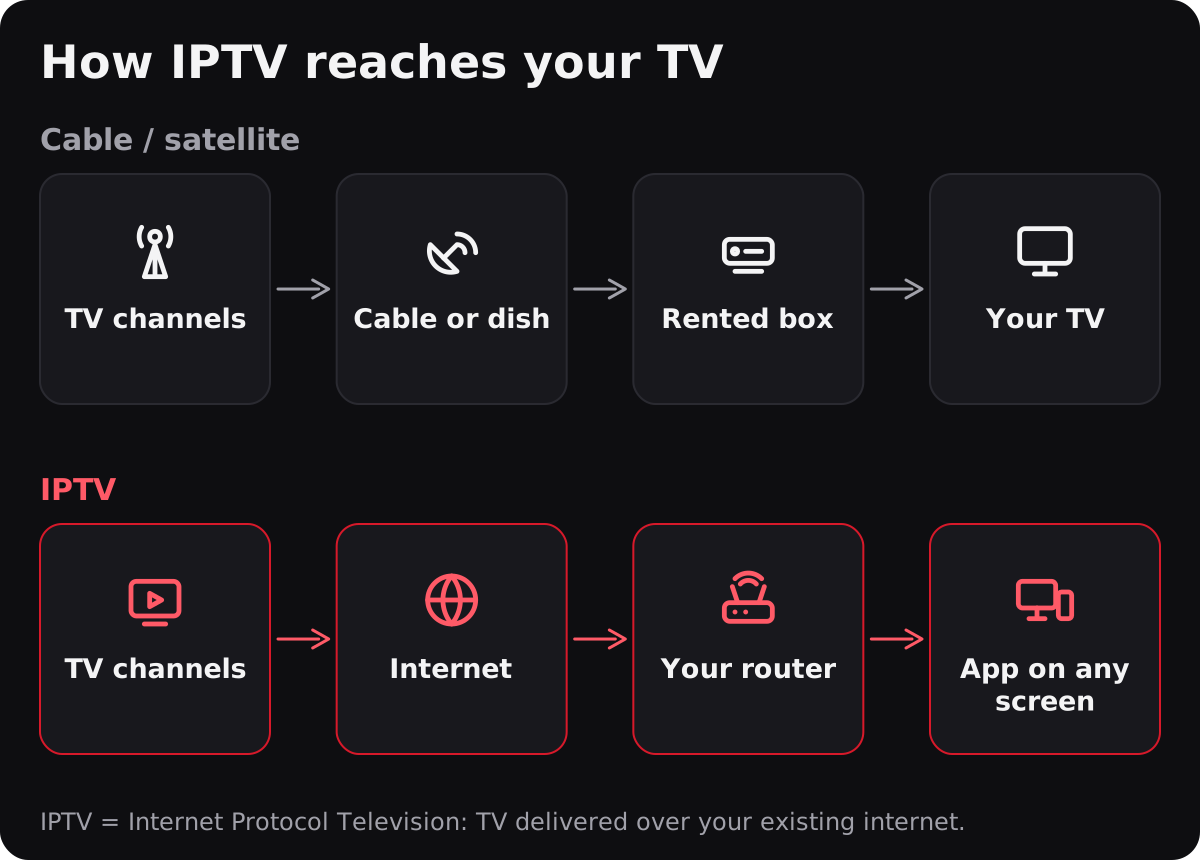
IPTV stands for Internet Protocol Television. Instead of reaching your TV through a coaxial cable or a satellite dish, live channels and on-demand shows travel over the internet connection you already have, to an app on your Smart TV, streaming stick, phone or computer.
From the viewer's side, IPTV usually means three things:
- Live TV channels, often with a TV guide, like cable.
- On-demand movies and series you can start whenever you want.
- An app or player (on a Smart TV, Fire TV, Android box, Apple TV, MAG box, phone or computer) where you sign in with your account.
You probably already use legal IPTV
IPTV is not a grey-market invention. Several of Canada's biggest TV services are IPTV services: Bell Fibe TV, TELUS Optik TV and Rogers Ignite TV all deliver television over an internet connection. Broadcasters' own apps, such as CBC Gem, ICI TOU.TV, Crave and TVA+, also stream TV over the internet. All of them are legal because they hold, or license, the rights to what they show.
So when is IPTV illegal?
The technology is never the problem. The question is always whether the provider has the right to distribute the channels and programs it offers. Under Canada's Copyright Act, retransmitting TV channels, live sports or movies without the rights holders' permission is infringement. Broadcasters and sports leagues pay a lot for those rights, and they actively protect them.
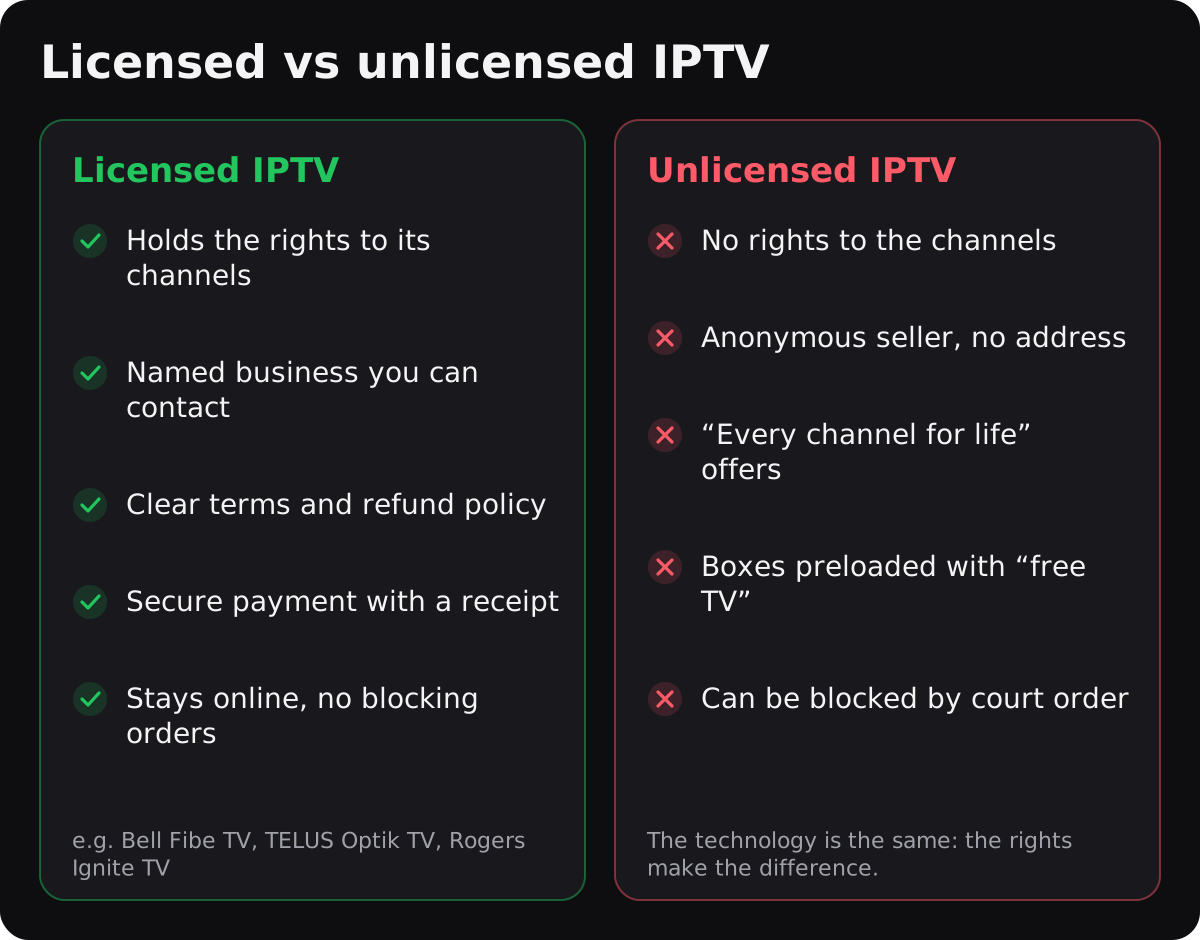
In practice, warning signs of an unlicensed service include an anonymous seller with no business name or address, “every channel in the world for life” offers, boxes sold preloaded with “free TV” apps, and no terms, refund policy or receipt.
What Canadian courts have decided
Since 2016, Canadian broadcasters have taken unlicensed IPTV services and sellers to court, and the Federal Court has given them new tools to stop them. The key decisions:
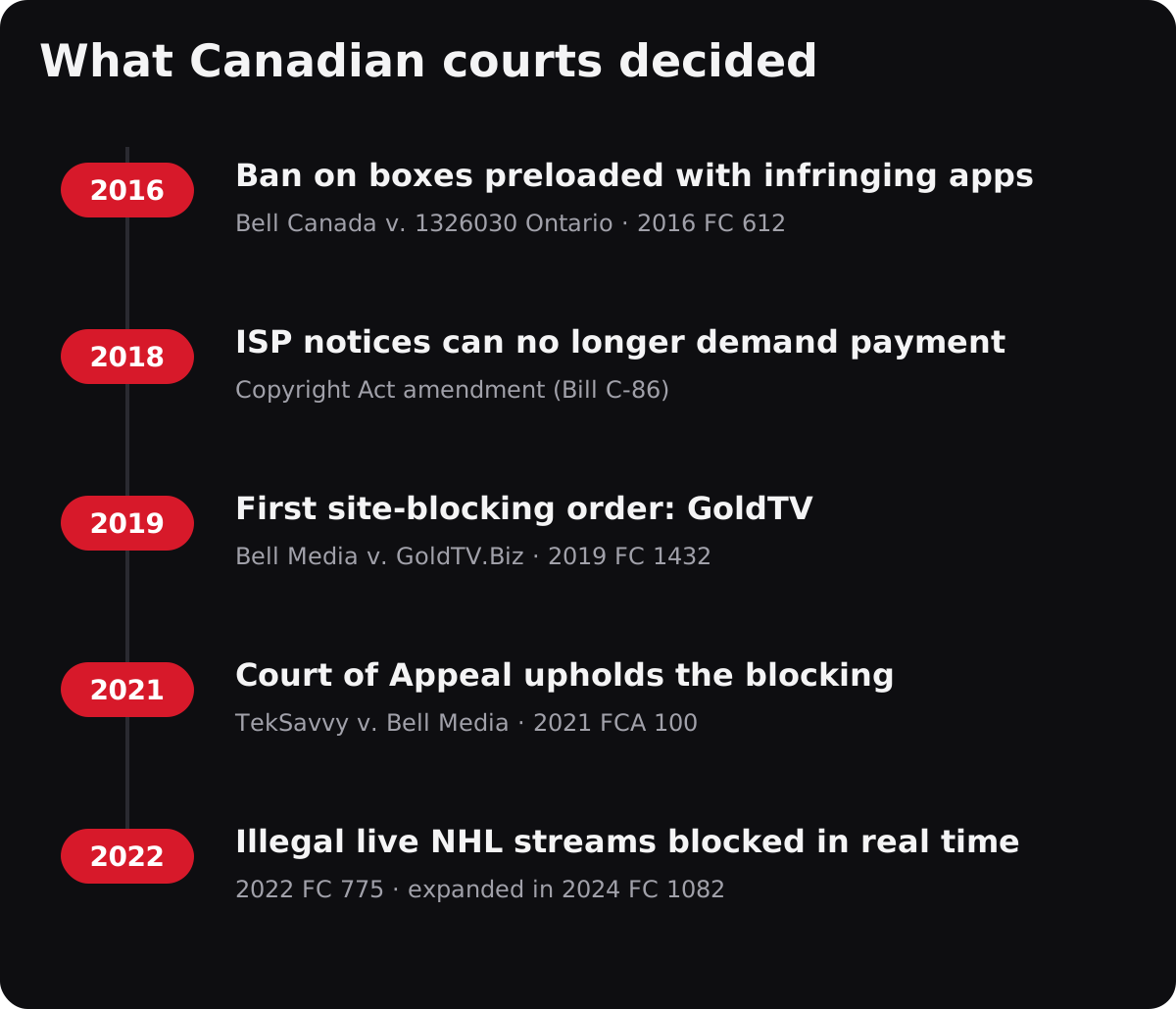
- 2016: in Bell Canada v. 1326030 Ontario Inc. (2016 FC 612), the Federal Court ordered sellers to stop selling set-top boxes preloaded with apps that give access to infringing streams. The Federal Court of Appeal upheld the order in 2017 (2017 FCA 55). Boxes without those apps were not affected.
- 2019: in Bell Media v. GoldTV.Biz (2019 FC 1432), the Federal Court issued Canada's first order requiring internet providers to block an unlicensed IPTV service.
- 2021: the Federal Court of Appeal upheld that blocking order (TekSavvy Solutions v. Bell Media, 2021 FCA 100), confirming that courts can order internet providers to block such services.
- 2022: in Rogers Media v. John Doe 1 (2022 FC 775), the Court issued Canada's first “dynamic” blocking order, letting broadcasters block servers streaming NHL games without permission in real time during games. A broader, two-year dynamic order followed in 2024 (2024 FC 1082).
What this means in practice: unlicensed services can disappear or stop working without warning, often in the middle of a season, and buyers usually have no refund and no one to contact.
What about viewers?
So far, enforcement in Canada has mostly targeted the businesses that sell or operate unlicensed services, not individual viewers. That doesn't mean watching unlicensed streams is risk-free:
- Notices: under the Copyright Act's notice-and-notice system, rights holders can send a notice of claimed infringement to your internet provider, which must forward it to you. Since a 2018 amendment, these notices cannot demand payment or ask for your personal information, so ignore any notice that does.
- Lawsuits: a rights holder who wants to sue a viewer needs a court order to identify them. For non-commercial infringement, the law sets statutory damages between $100 and $5,000 for all infringements in a lawsuit, as decided by the court.
- Practical risks: apps from unknown sources can carry malware, payment details can be misused, and a service can be shut down or blocked, leaving you with nothing.
A VPN doesn't change any of this. Using a VPN is legal in Canada, but it doesn't make unlicensed content legal.
5 checks before you pay for IPTV
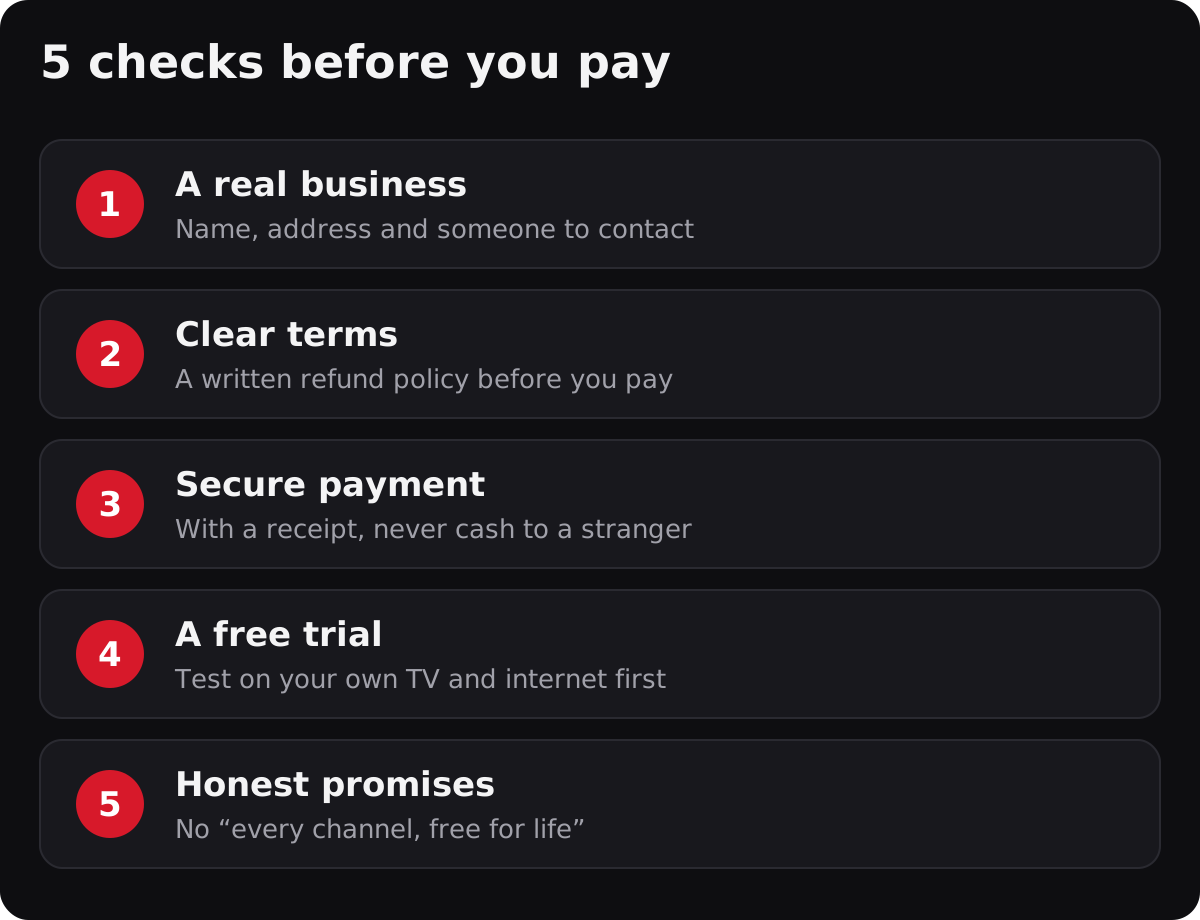
- A real business: a business name, an address and a way to reach a person.
- Clear terms of service and a written refund policy you can read before paying.
- Secure payment with a receipt, not cash or a transfer to a stranger.
- A free trial, so you can test the service on your own TV and internet first.
- Honest promises: no “every channel in the world, free for life” and no preloaded “free TV” boxes.
Where IPTVB stands
IPTVB is run by a named Canadian business, with Terms of Service, a 30-day refund policy and support in English and French, 24/7, on WhatsApp and by email. You can try it free for one month, no credit card needed.
Frequently asked questions
Is IPTV legal in Canada?
Yes, IPTV as a technology is legal in Canada: Bell Fibe TV, TELUS Optik TV and Rogers Ignite TV are IPTV services. A service becomes illegal when it streams channels or programs without the rights to them.
Is it illegal to watch unlicensed IPTV in Canada?
Streaming copyrighted channels without permission can be copyright infringement. Enforcement has mostly targeted sellers and operators, but viewers can receive notices through their internet provider, and courts can award statutory damages of $100 to $5,000 for non-commercial infringement.
Are IPTV boxes and Firesticks legal in Canada?
Yes. Devices like a Fire TV Stick, an Android TV box or a MAG box are legal. In 2016 the Federal Court stopped the sale of boxes preloaded with apps that give access to infringing streams; it's the preloaded content, not the device, that is the problem.
Is IPTV Smarters legal?
Player apps such as IPTV Smarters, TiviMate or VLC are legal: they just play the streams you sign in to. Whether your viewing is legal depends on the service you connect them to.
Does a VPN make IPTV legal?
No. Using a VPN is legal in Canada, but it doesn't change whether the content you watch is licensed.
Can a copyright notice from my internet provider make me pay?
No. Since a 2018 amendment to the Copyright Act, notices forwarded by your internet provider cannot demand payment or personal information. To sue you, a rights holder would first need a court order to identify you.
This article is general information, not legal advice. For a specific situation, consult a lawyer. Last reviewed in November 2026.